











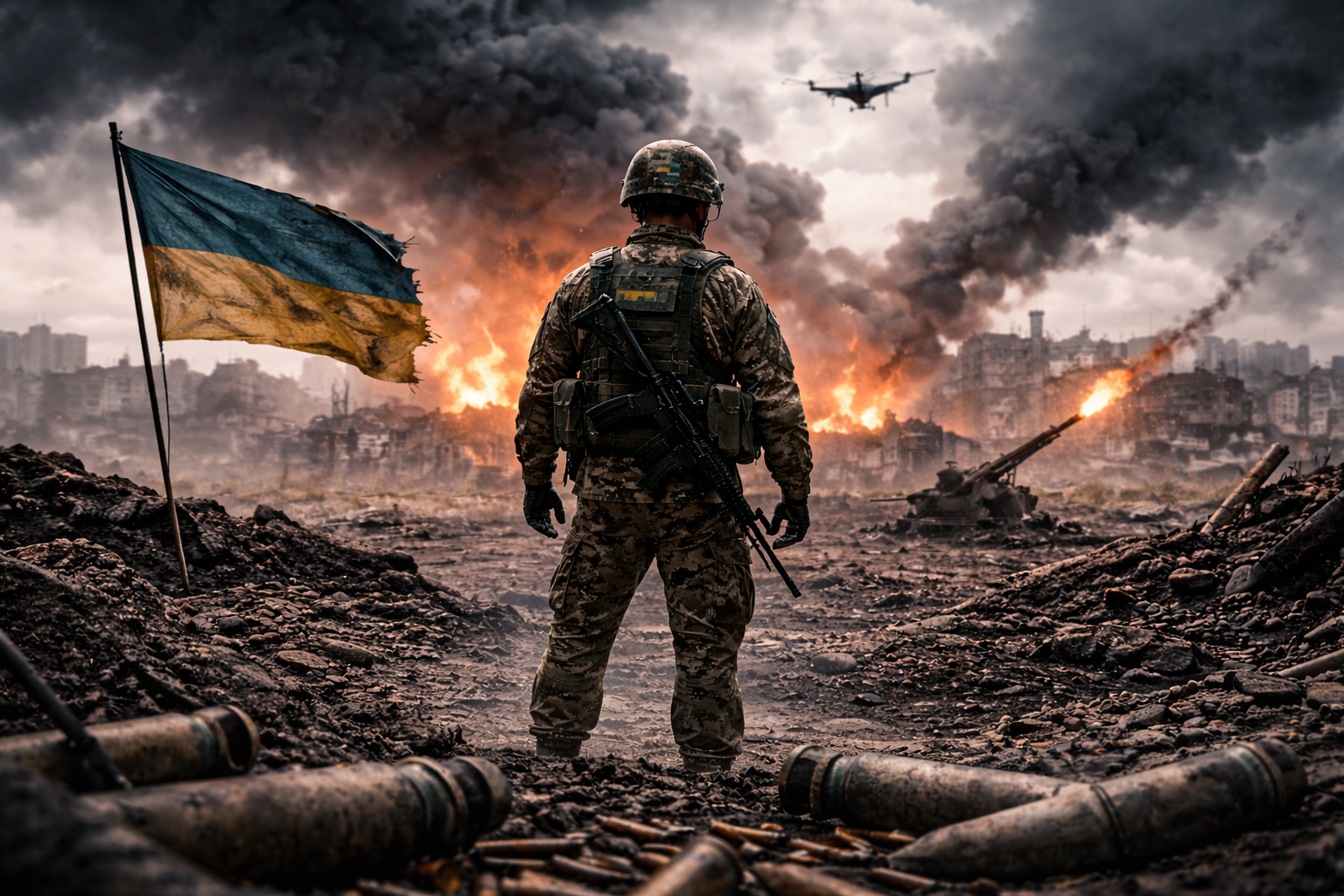
Ukraine has survived on courage for nearly four years. That courage stopped Russian columns outside Kyiv, blunted early offensives, and held a front stretching more than a thousand kilometers.
But wars of this length stop responding to courage alone. It is evident that Ukrainian soldiers are willing to fight.
But the harder part is whether the state can still supply enough men, shells, air defence, and cash to keep the war from tilting decisively against it.
And the numbers are getting hard to interpret.
The infantry problem that won’t go away
Ukraine’s most severe military shortage is its infantry. Trained infantry who can rotate, rest, and return to the line.
Multiple independent reports are now stating that Ukrainian units are holding positions with too few soldiers, for too long, with too little relief.
In some parts of the front, Russian infantry reportedly outnumber Ukrainian forces by as much as ten to one.
Even Ukrainian President Volodymyr Zelensky has publicly cited ratios of three to one overall and up to eight to one around key hubs like Pokrovsk.
The human consequences show up in official figures. Ukrainian prosecutors have opened hundreds of thousands of cases linked to absence without leave or desertion since 2022.
Though the precise number varies by source, the trend is clear, as more than half of these cases were recorded in 2025 alone.
Some frontline brigades are now so depleted that commanders accept returning deserters simply to fill trenches.
Drone warfare has made this worse. Small units survive longer in static positions, but rotations have become lethal. Moving men in and out is often deadlier than staying put.
Medics face drones that reach deeper than ever. Soldiers remain forward for months at a time.
One widely cited case involved two Ukrainian troops holding a position for 165 days under constant fire.
Ammunition decides who bleeds
Attrition wars punish the side that runs short of firepower faster than the side that runs short of ideas. Artillery and missiles account for the vast majority of battlefield casualties on both sides.
Several estimates put the casualties caused by artilleries close to 80%, but the exact share matters less than the effect.
When Ukrainian artillery fire drops, Ukrainian casualties rise sharply.
One reported episode in late 2024 highlighted that when Ukrainian units were forced to cut daily artillery fire from 10,000 rounds, daily deaths tripled.
The mechanism is simple. Fewer shells mean Russian infantry can move. Ukrainian infantry must then absorb the advance with bodies instead of steel.
Western production has not caught up. US output of 155mm shells was around 40,000 a month in mid-2024 and is still not expected to reach the long-promised one hundred thousand per month until mid-2026.
Europe has expanded production, but not fast enough to remove rationing. Ukrainian commanders continue to delay counterattacks because they cannot afford the ammunition bill.
Air defence shortages compound the damage. Fewer interceptors mean more successful Russian strikes on energy infrastructure. That leads to blackouts, lost industrial output, and a weaker rear economy that must still pay soldiers and build drones.
Air defence is not only about cities but also about keeping the state functioning while the war continues.
Russia’s advantage is endurance
Russia’s battlefield performance remains costly and slow. But its strategic position is clearer. Moscow has reshaped its economy purely for war.
Defence spending is now around 7-8% of GDP. The military reportedly consumes close to 40% of the federal budget.
Energy exports still fund roughly a third of state revenues, even after sanctions and price caps.
Russia produces shells, missiles, and drones an industrial scale.
It supplements domestic output with imports and technology from China, Iran, and North Korea.
Western analysts increasingly agree that, absent a severe internal shock, Russia can sustain its current war effort for several more years.
This matters because attrition rewards the side that can keep paying the bill. Russia can absorb higher losses because its population is larger and its mobilisation pool deeper.
Ukraine cannot replace casualties at the same rate.
Every month of delay in stabilising funding and supplies shifts the balance slightly further against Kyiv.
A budget built on hope, not cash
Ukraine’s 2026 budget exposes the financial strain more clearly than any battlefield map.
Revenues are projected at roughly $69bn. Planned spending is almost $114bn.
Defence and national security account for more than a quarter of GDP.
Debt servicing alone will cost over $12bn.
But the Ministry of Defence allocation is lower than in 2025. Funding for maintaining the armed forces has been cut by nearly $5bn in hryvnia terms. Spending on weapons procurement and modernisation is also reduced.
This follows a pattern seen in 2024 and 2025, when initial budgets proved wildly optimistic and had to be revised multiple times upward as war costs rose.
Ukraine’s own finance ministry estimates that the state will need about $49bn in external support in 2026.
That is roughly 43% of total spending. The financing gap for 2026 and 2027 combined is around $60bn, a figure broadly echoed by the IMF.
A new IMF program may deliver just over $8bn across four years. It certainly helps, but does not solve the problem.
Zelensky has been blunt with European leaders. Without fresh funding by spring, Ukraine will have to cut drone production.
Drones are one of the few areas where Ukraine offsets its manpower disadvantage. Losing that edge would accelerate the attrition spiral.
Europe’s late but telling choice
Europe’s struggle over how to finance Ukraine exposed its own limits.
For months, EU leaders debated using frozen Russian assets to back a large loan. Legal risks and internal divisions, especially in Belgium, where most assets are held, killed the plan.
What emerged instead was a €90bn loan backed by unused EU budget funds.
For Ukraine, the result matters more than the method. The money will arrive sooner than under the abandoned plan and may prevent a spring liquidity crisis.
For Europe, the significance is deeper. The deal was agreed without unanimity and with opt-outs for reluctant states. That sets a precedent.
It shows the EU can, under pressure, create shared financial power to pursue security goals.
Still, €90bn does not cover Ukraine’s full needs through 2027. Aid volumes have fallen sharply in recent months.
Without further commitments, Kyiv will continue operating on short planning horizons, unable to lock in contracts for ammunition, air defence, and equipment at the scale the war demands.
At the end of the day, Europe is nearing irrelevance in shaping the war’s outcome because it has failed to match its diplomatic rhetoric with sufficient financial and military power.
Money and weapons are the currency of influence. And Ukraine is increasingly dependent on Europe.
If nothing structurally changes, 2026 becomes Ukraine’s inflection year, where the front can hold in places, but Kyiv’s ability to prevent operational ruptures and to negotiate from strength will deteriorate.
The post Why 2026 could decide Ukraine’s war as manpower and resources are running thin appeared first on Invezz