





“GLP-1 drugs don’t just change what people eat,” Karthik Srinivasan, communications strategy consultant, tells Invezz.
They change whether people want to eat at all. That’s why this stops being a marketing problem and becomes a business-model problem for a whole lot of categories.
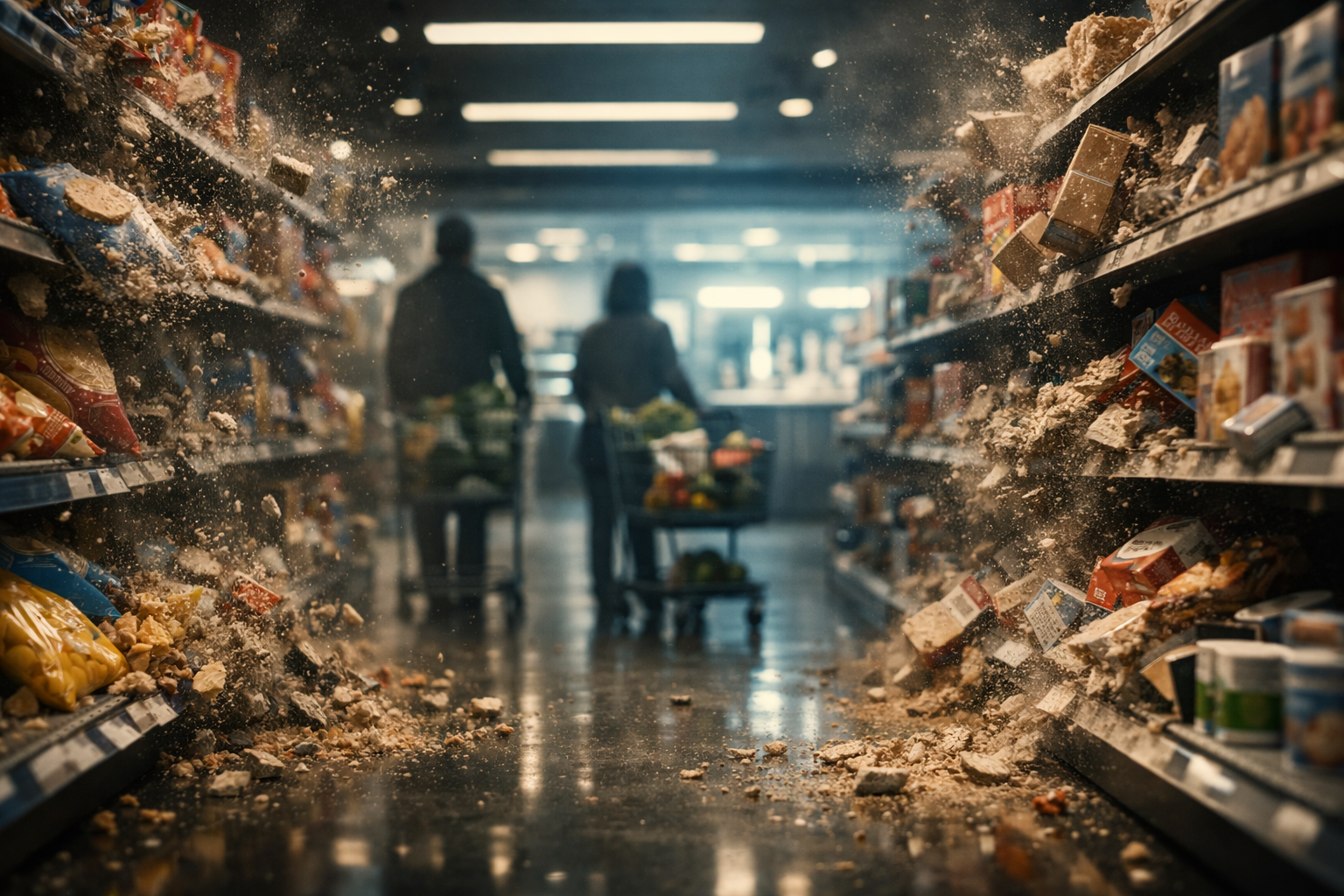
The weight-loss drug boom didn’t just spark a health revolution—it’s triggering a retail earthquake.
As Ozempic, Wegovy, Mounjaro, and other GLP-1s surge into mainstream life, grocery budgets are collapsing: down 5.3% to 8.2% in just six months, with higher-income households cutting spending by as much as 8.6%.
And the hardest hit isn’t dinner—it’s the snack aisle.
Impulse favourites are fading fast: savoury snacks fall by 10.1%, sweets drop by roughly 8%, and baked goods slide by 7.5%.
Only yoghurt and fresh produce are seeing gains.
KPMG forecasts the scale of this shift: a $48 billion annual reduction in food and beverage spending through 2034.
This isn’t a cyclical dip—it’s appetite suppression that sticks, creating demand destruction that looks permanent.
By 2030, Circana predicts that GLP-1 users will account for 35% of all food and beverage sales. When biology says “no more,” marketing simply can’t compete.
From marketing problem to business-model crisis
Traditional food industry thinking assumes consumer desire exists.
A company’s job was to find the cravings, make them irresistible through packaging design and taste engineering, and sell more volume.
GLP-1 drugs obliterate that assumption.
According to Morgan Stanley research, 66% of GLP-1 users have reduced their snacking frequency from three or more daily snacks to two or fewer.
That’s not a messaging failure, it’s a neurological reset.
The medications decrease appetite and suppress hunger cravings by affecting the brain’s reward systems.
Approximately 85% of GLP-1 users report significant taste and appetite changes, with 74% actively avoiding fatty foods and 67% skipping sweets entirely, a study by International Flavors & Fragrances (IFF) noted.
“Marketing assumes that a desire to consume food exists,” Srinivasan notes.
GLP-1s suppress that desire at the source. Brands cannot simply message their way out of muted appetite.
The implication is profound: traditional advertising that taps into cravings and emotional eating no longer functions when the neurological machinery that generates those impulses has been chemically disabled.
The shrinkflation paradox applies here, but in reverse.
Traditional shrinkflation, where a smaller package is sold at the same or higher price, is effective when the consumer doesn’t notice.
But GLP-1 users are acutely aware of portions and increasingly price-conscious.
Srinivasan explains the nuance:
Selling smaller portions at premium prices can work, but only for brands that are genuinely premium to begin with. That is, those that offer density, purpose, or experience rather than just volume. For everyone else, shrinking packs without rethinking value will definitely feel like stealth inflation, not innovation.
A smaller candy bar at the same price isn’t perceived as clever pricing; it’s perceived as poor value compared to a larger, high-protein alternative at a higher absolute cost.
Which food giants are actually failing?
The damage isn’t uniform, but it’s concentrated in the wrong places for traditional snackers.
PepsiCo has posted five consecutive quarters of declining savoury snacks volume.
Mondelez International recorded unfavourable volume and mix across all regions, with North America down 2.4% points, driven by soft demand for biscuits, baked snacks, and candy.
Hershey, the confectionery titan, acknowledged a “mild” year-on-year impact in November 2024, carefully worded language masking deeper structural concern.
The company saw North American salty-snacks net sales fall 15.5% year-over-year, with volume-and-mix declining 17%.
For a company projecting 2-4% long-term growth, this represents a significant shortfall.
The vulnerability isn’t distributed evenly. Ultra-processed, calorie-dense categories: chips, cookies, confectionery, sugary drinks, face the fiercest headwinds.
A separate KPMG analysis found that GLP-1 users reduce annual caloric intake by 21% and monthly grocery spending by 31%.
Over a decade, that compounds into an industry restructuring.
Analyst views range from conservative to aggressive: Piper Sandler estimates 20-30 basis points of impact on confectionery and salty snacks, while the broader $48 billion spending reduction forecast suggests significantly steeper headwinds for certain categories.
The restaurant collapse nobody’s talking about
Fast-food and limited-service restaurant spending has declined 8% among GLP-1 users, with 54% of GLP-1 users reporting they dine out “significantly less” or “less” frequently since starting medication.
The quick-service restaurant (QSR) model, built on the premise that consumers crave dopamine hits from highly processed, high-sodium, high-fat foods consumed quickly, fundamentally depends on appetite as a driver.
When appetite is chemically suppressed, that model fractures.
“The deeper challenge is that much of the food industry has been built on encouraging consumption beyond hunger,” Srinivasan explains.
This means more snacking, more frequency, and more indulgence. GLP-1 drugs expose that dependency. When biology—induced by GLP-1 drugs—says ‘enough’, there’s not much that brand storytelling can do.
The bifurcated market: Who wins, who dies
Here’s where the story becomes nuanced.
The snacking market isn’t disappearing; it’s fragmenting.
By 2030, 35% of US households will include a GLP-1 user. The remaining 65% will continue eating snacks with historic frequency.
But those two populations have fundamentally different needs. One seeks nutrient density within severely constrained portions.
The other seeks dopamine and indulgence. These are incompatible consumer bases.
Harish Bijoor, brand strategist, captures the complexity while speaking with Invezz:
Brands and products, particularly in the snacking industry, are all about hunger. When hunger itself is suppressed, then the market itself tends to get suppressed. The good point for the snack food brands, however, is the fact that not too many folk will go behind appetite suppression.
Yet he adds crucial context:
Appetite suppression is going to be a route that a whole host of people will take who are in a high-risk category when it comes to obesity. At the same time, the market that is not into these drugs is going to continue at a frenetic pace.
The winners are becoming clear: protein snacks. The global protein-snacks market is projected to grow at 8.7-9.1% CAGR from 2025 to 2035, expanding from $4.92 billion today to $10.83 billion by decade’s end.
Plant-based protein snacks dominate with 62.8% market share. High-protein bars, jerky, and nutrient-dense alternatives are capturing shelf space and consumer loyalty.
But the real validation comes from operators on the front lines.
“Yes, it’s true people are shifting to weight-loss medications, but that’s only part of the truth,” Kunal Singal, Executive Sous Chef at Hyderabad-based ROAST CCX, told Invezz.
In general, people are becoming more aware of what’s good and bad for them in the long run. Demand isn’t reducing; it’s shifting to healthier versions. If you’re selling fried potato chips, you’ll face a significant downfall. But if you’re selling beetroot chips, you’ll see sales increase every quarter.
“The fine-dining model won’t be majorly affected as long as menus are redesigned for new consumption needs, which is happening rapidly across the industry. The future is always a combination of great experience and healthy food,” Kunal added.
Singal’s observation reflects what’s happening across the food landscape: it’s not universal collapse, it’s intelligent adaptation.
The losers, traditional confectionery, commodity salty snacks, and calorie-dense baked goods, are those betting on yesterday’s consumer.
Morgan Stanley forecasts consumption of ice cream, cakes, cookies, candy, chocolate, frozen pizzas, chips, and regular sodas could decline up to 3% by 2035.
The algebra is simple: fewer consumers with an appetite for those categories, combined with non-GLP-1 consumers in this cohort reducing intake, equals secular decline.
The innovation imperative: Adaptation or extinction
Leading companies are betting on repositioning rather than defending legacy snacks.
Nestlé launched Vital Pursuit, a line of frozen meals explicitly designed for GLP-1 users, featuring portion control, high protein content, essential nutrients, and transparent positioning.
Sales have been robust enough that the company is expanding the line.
Notably, 77% of Vital Pursuit sales come from households without current GLP-1 users, suggesting health-conscious consumers broadly are adopting these products.
Conagra introduced “On Track” badges on 26 Healthy Choice frozen meals in early 2025, flagging products as high-protein, low-calorie, and fiber-rich.
PepsiCo’s acquisition of Siete, a plant-based snacking brand, positions the company in functional, protein-forward categories away from commodity salty snacks.
These aren’t defensive moves; they are strategic repositioning.
The critical distinction from previous food-company pivots is this: survival doesn’t come from selling less food for more money.
It comes from redefining the purpose of the product itself.
The venture capital signal
If you want to understand where food-industry growth is actually happening, follow venture capital.
Berry Street, a platform connecting GLP-1 users with registered dietitians, raised $50 million in 2025.
Fay Nutrition, an AI-powered preventative-care platform pairing patients with licensed nutritionists, raised $50 million in Series B funding from Goldman Sachs and General Catalyst.
Grüns, a nutrient-dense gummy brand, raised $35 million in Series B funding in 2025, money flowing to products formulated to fill nutritional gaps in bodies consuming 40% fewer calories than baseline.
These aren’t marginal bets.
They reflect investor conviction that the $190 billion opportunity lies in serving intentional, nutrient-dense consumption, not traditional snacking.
When biology beats marketing
When 35% of consumers have chemically suppressed appetite by 2030, snacking brands cannot message their way to growth.
The companies that survive will be those that acknowledge this shift as permanent, that reposition toward protein-rich, functional nutrition, and that serve intentional consumption rather than cravings.
Traditional snacking, built on the premise of appetite-driven impulse purchases, faces decline.
The bifurcation is already underway. Kunal Singal’s observation captures the reality: demand isn’t disappearing, it’s shifting.
Winners are building for the health-conscious, intentional-eating future. Losers are defending the junk-food past.
As Srinivasan concludes:
When biology says ‘enough’, there’s not much that brand storytelling can do.
The companies that win will be those that build for the GLP-1 demographic today, not those betting the demographic shrinks tomorrow.
The post How weight-loss drugs are destroying big snacking, erasing billions in sales appeared first on Invezz